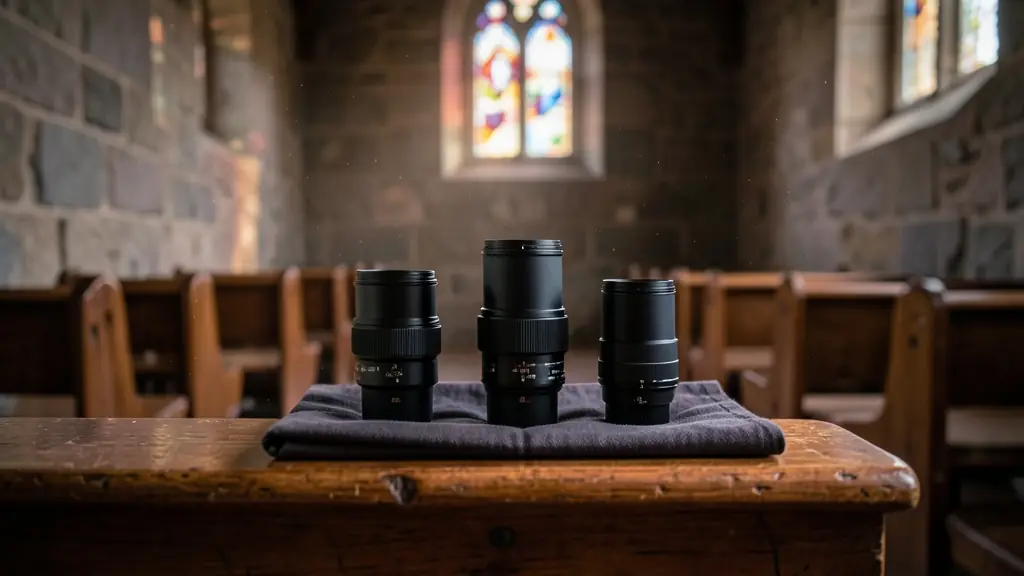
The camera records the picture, but the lens decides what it looks like: how much of the church fits in, whether the background melts away behind a speaker, and whether you can still film when the lights drop for the first dance. Good lenses for videography also outlast two or three camera bodies, so this is where a careful buyer spends. Tell suppliers what you film and where, and a camera shop or rental house can quote the two or three lenses that do the work.
Zoom or prime: speed against flexibility
A zoom covers several framings without changing glass, which matters when the bride is walking and you have one chance. A prime has one focal length but usually lets in far more light and costs less for the same sharpness. Most wedding and event shooters carry a standard zoom for coverage and one or two fast primes for low light and close moments. Run the numbers for your room with the field of view calculator before you choose.
A working set of focal lengths
- 24 to 70 type zoom: the workhorse for ceremonies, launches and run and gun days.
- A wide, around 16 to 24: a small hotel room on the getting ready morning, a real estate walkthrough or a crowd from the stage.
- A 50: natural framing for a seated interview, and bright enough for a candlelit reception.
- An 85 or a 70 to 200 type zoom: vows from the back of the church without walking down the aisle, or a keynote from the sound desk.
On an APS-C or Super 35 body each of these looks about 1.5x tighter, so a 35 there frames much like a 50 on full frame.
Aperture and the dim church problem
Many old churches and community halls are far darker than they look to the eye. An f/2.8 zoom manages most of them; an f/1.4 or f/1.8 prime lets you keep the ISO down and the shadows clean. Remember that a wide open aperture also gives a thin slice of focus, so a couple who sway during vows can drift soft. Light still beats glass: a small video light often solves more than a faster lens.
Video problems a stills review will not mention
Ask about focus breathing, where the frame visibly grows or shrinks as focus moves, and about autofocus motors that click loudly enough for the camera mic to catch. A stabilised lens helps on handheld shots when no gimbal is on hand. Cine lenses have geared focus rings, smooth long focus throws and no click in the aperture, which suits planned shoots with a focus puller. Adapters can mount older glass, but check that autofocus and stabilisation still work through them.
What to put in your request
- Give your camera body and its mount
- Say what rooms and distances you film at
- Mention autofocus or manual focus preference
- Ask if hire before buying is possible
- Say if used lenses are acceptable
Videography Lenses: who asks for them and why
- Couples and their families: a long lens that catches the vows from the back without crossing the aisle
- Families: matric dances, 21sts, memorials: a fast prime that keeps a dim school hall at the matric dance clean and bright
- Companies, SMEs and agencies: a 50 or 85 for tidy interview framing with the office softly out of focus
- Event organisers, venues and conference planners: a telephoto zoom from the sound desk that frames the keynote speaker tightly
- YouTubers, podcasters and content creators: a wide prime for talking to camera at arm's length in a small bedroom studio
- Musicians, bands, DJs and choirs: cine primes with geared rings for planned focus pulls in a performance video
- Estate agents, developers, lodges and venues: a wide zoom that shows a whole lounge or lodge deck without distorting the walls
- Churches, schools, NGOs and sports clubs: a standard zoom that covers the pulpit, the choir and the congregation in one