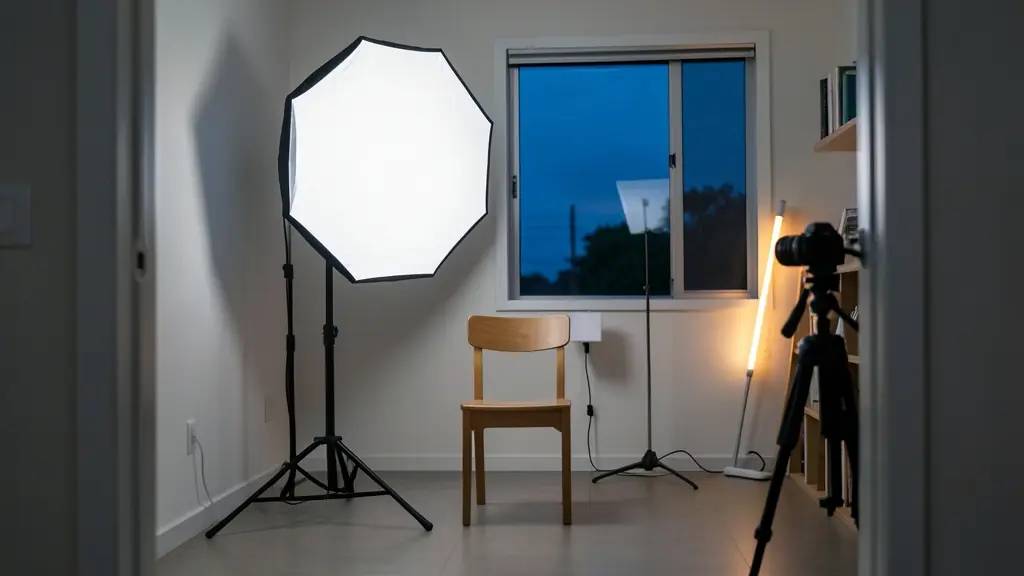
Put a cheap camera in good light and a costly one in a dim office, and the cheap camera wins. Studio lighting for video is about control: a soft key on the face, enough fill so the shadows do not swallow an eye, and a touch of light behind to lift the subject off the wall. Videography lights today are almost all LED, cool to touch and able to run off batteries, which matters when load shedding hits halfway through an interview.
Panels, COB lights, tubes and on camera lights
- LED panels: flat, light and quick to rig; good as fill or for a small room.
- COB lights: one bright chip in a housing that takes a softbox, a lantern or a reflector. The usual key for interviews and podcasts.
- Tube lights: slim, often colour changing, for a background glow, a car interior or a music video.
- On camera lights: small and battery powered, for a dark reception table. Flat and harsh if used alone.
Colour temperature and CRI in plain words
Daylight sits around 5600K and looks blue beside old tungsten bulbs at about 3200K. Bi colour lights cover both, so you can match a window or a warm restaurant. Set every light and the camera to the same value, or skin goes orange on one side and grey on the other. CRI, and the similar TLCI, rate how faithfully a light shows colour: look for 95 or above, because cheap LEDs at lower values tint skin green and no grade fully fixes it.
Three point lighting for an interview
Place the key light high, about 45 degrees to one side of the speaker, through a softbox for gentle shadows. Add a dimmer fill on the other side, or just a white reflector. Put a small back light behind and above the speaker to rim the hair and shoulders. Switch off the overhead fluorescent tubes if you can; they add flicker and a green cast. When a window is in shot, balance your lights to daylight rather than fight it, and add a gel or diffusion where the venue's lights clash.
Power, load shedding and a small home kit
Many lights take V mount batteries, which travel in the hand and keep running when the grid goes down. Ask the supplier how long one battery runs a light at full and at half power, then check it with the battery runtime calculator; remember airlines limit large lithium batteries in luggage. A first kit for a podcast or social media video corner is one COB light with a softbox, one small panel and stands with sandbags. For live streaming a church or a talk, plan lights on a UPS or a generator as well.
What to put in your request
- Say what you light: interviews, podcast, events
- Give the size of the room or set
- Mention battery power or load shedding
- Ask for CRI and flicker free ratings
- Say if you need stands and softboxes too
Video Lighting: who asks for them and why
- Couples and their families: a soft light on the speeches table so faces stay clear after the sun goes down
- Families: matric dances, 21sts, memorials: a small panel that lights a grandparent's story for a family history interview
- Companies, SMEs and agencies: a three light setup that turns a boardroom into a clean interview set for staff videos
- Event organisers, venues and conference planners: battery lights at a registration desk or red carpet when venue lighting is too dim
- YouTubers, podcasters and content creators: a softbox key and a coloured tube behind for a podcast or tutorial corner at home
- Musicians, bands, DJs and choirs: tube lights and gels that shape the mood of a performance shot in a dark warehouse
- Estate agents, developers, lodges and venues: lights that lift a dark passage or bathroom so a walkthrough looks even and true
- Churches, schools, NGOs and sports clubs: lights on the pulpit and choir so a streamed church service looks clear and warm