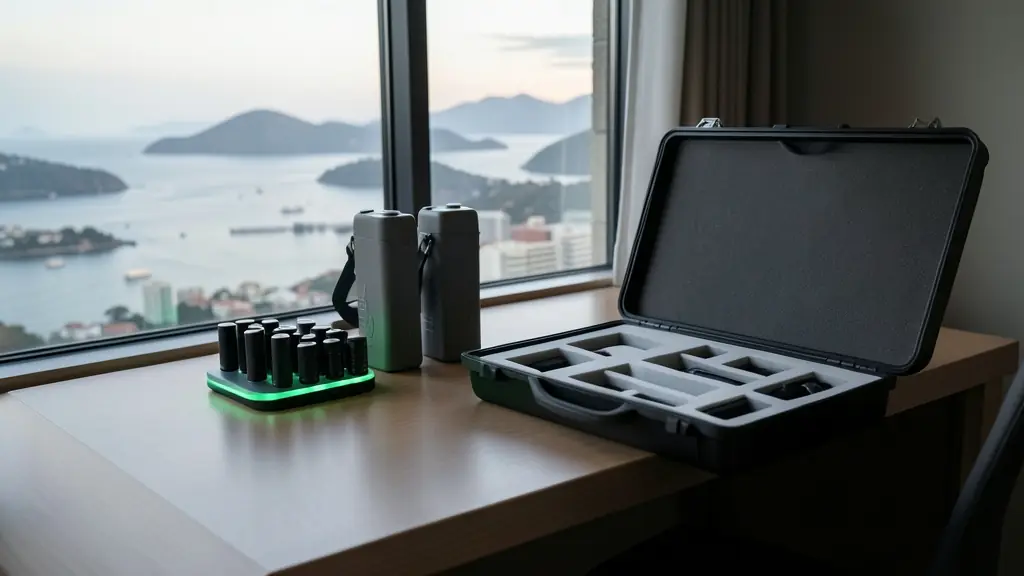
Flat batteries ruin more shoots than broken cameras. This calculator takes a battery's size and the power of what it runs, a camera, an LED light, a field monitor or a wireless receiver, and tells you how long it lasts, how many to charge the night before and whether you can take them on a plane. Pair it with video lighting for light draws, wireless microphones for receivers, or work out the day with the wedding timeline planner.
Watt hours in, minutes out
A battery's energy is in watt hours, printed on the label. If only volts and milliamp hours are given, multiply volts by amp hours: 14.8 V and 6.6 Ah is about 98 Wh. Divide by the draw in watts and you have the hours, but a device never gets the full figure: converters waste some, cold mornings in the Karoo cut capacity and old cells hold less. The tool keeps 85% of the label figure.
A 98 Wh battery on a 60 W COB light gives 98 x 0.85 / 60, about 1 hour 23 minutes. Four hours of interviews need three; with a quarter added for spares, bring four.
The flight rule for lithium
The airline industry's rule for passengers works on watt hours. Up to 100 Wh, spares go in hand luggage with no approval, up to 20 a person. Over 100 Wh and up to 160 Wh, spares need the airline's approval and you may take two. Above 160 Wh a battery cannot travel as a passenger's spare at all and ships as cargo. Spares never go in checked bags, and each needs its terminals taped or its own pouch. Airlines may be stricter, so check before you fly to a destination wedding.
Load shedding and long days
A venue that loses power in the middle of the reception takes the charger with it. Charge everything the night before, keep one battery on a car charger, and count lights separately from the camera because they drain fastest. The draw presets are typical figures; the real one is on the light's label or the camera's spec sheet.
Frequently asked questions
Why is my runtime shorter than the label suggests?
Can I take a 150 Wh battery to Durban by plane?
Do power banks count?
Do you sell batteries or hire gear?
More calculators
- Footage storage calculatorCameras, hours and bitrate in, gigabytes, cards and backup drives out
- Live stream bandwidth calculatorQuality and destinations in, upload speed and data used out
- Field of view calculatorSensor, focal length and distance in, angle and frame size out
- Wedding video timeline plannerThe day's times in, hours of coverage, crew and overtime out
- Videography budget estimatorKind of shoot, hours, crew and extras in, a rough rand range out
- Aspect ratio calculatorResolution and target ratio in, crop, bars and delivery sizes out